
A few days ago, domestic and international media outlets widely reported a harrowing incident: in a village in India, a child playing by the water was swallowed alive by a crocodile. The news sent shockwaves through many hearts. The reports further detailed how the villagers eventually hunted down the reptile, sliced open its belly, and recovered the child's remains.
It was an agonizing tragedy, yet it forces an unsettling question to the surface:
Do crocodiles exist solely in our rivers, ponds, and lakes?
Or are there predators lurking right among us?
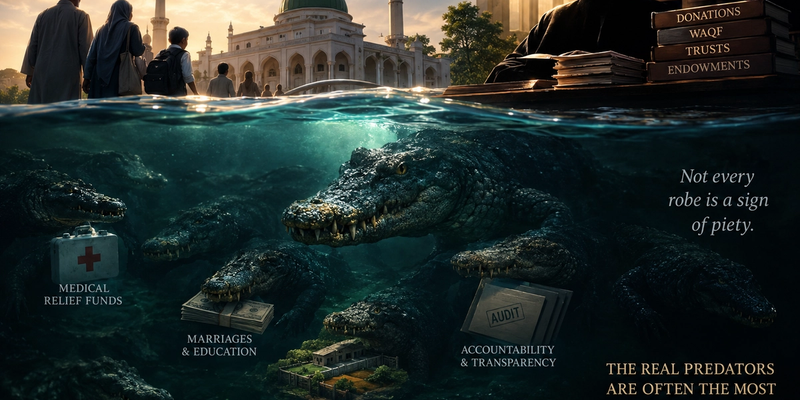
The only difference is that their teeth remain hidden, their gaping jaws are out of sight, and no bloodshot fury shows in their eyes. They drape themselves in religious attire, seek refuge under venerated names, and circle around seminaries, trusts, Waqf endowments, and ecclesiastical offices. Because of this veneer, no one senses the imminent danger.
Yet the moment prey appears, they strike.
These are the crocodiles of our religious institutions.
This metaphor is not directed at every scholar, teacher, jurist, or religious official. Dedicated, sincere servants of the faith are entirely blameless. Rather, this is aimed at those who exploit the public trust, donations, endowments, and sacred deposits given in the name of religion, twisting them into instruments of personal gain, influence, and unbridled authority.
Their most dangerous trait is their patience: they float motionless in the calm waters of these institutional pools.
Outwardly harmless.
Outwardly aggrieved.
Outwardly devoted to public service.
Yet the moment funds arrive for a desperate soul, an orphan’s plea surfaces, donations gather for a patient's medical care, philanthropists extend support for a destitute girl’s wedding, a benefactor covers a struggling student’s tuition, or aid pours in for the oppressed abroad—their eyes suddenly glint with greed.
To them, this is their prey.
Medical Relief Funds
Consider this: an impoverished man knocks on the door of a religious center, accompanied by his ailing mother, father, wife, or child. He genuinely believes relief awaits him there. A benefactor donated specifically for this cause; someone gave a portion of their hard-earned wealth; perhaps a donor even sacrificed their own family’s desires to send a few thousand rupees so a desperate patient could reach a hospital.
Yet, before that money can ever reach the afflicted, multiple predatory hands seize it. Files circulate aimlessly, bureaucratic influence is solicited, and the petitioner is ultimately turned away with a few measly coins or worn-out banknotes.
This is no longer merely financial corruption.
Here, in utter silence, an ailing human being’s hope is murdered—and not an eyelid bats.
A crocodile does not merely swallow flesh; sometimes, it devours hope.
Abroad, a well-meaning donor rests under the impression that a portion of his hard-earned wages is alleviating hardship. He trusts the institution. He remits the funds. Yet he never discovers which cabinet drawer the cash was locked into, into whose personal bank account it was funneled, through whose hands it slipped, or whose household it ultimately furnished.
To the donor, it was charity, sacrifice, and piety. To the predator, it was sheer opportunity. The cunning beast never surfaces onto dry land; it remains submerged, lures the quarry near, snaps its jaws shut, rolls, and plunges back into the murky depths.
Exploiting Marriages and Education
What scene could be more heartbreaking than an impoverished father pleading for assistance to marry off his daughter? A philanthropist provided funds earmarked for wedding essentials or the dowry. Tears stream down the father's cheeks; an uncertain chapter awaits his daughter.
If avarice strikes even at such a vulnerable moment, recognize that more than money was stolen: they robbed a father of his dignity, a bride of her joy, and a family of its prayers.
Such predators must be asked: Did you merely pocket cash, or did you also write that broken father’s silent curse into your destiny?
Consider the child holding a book with empty pockets—one yearning to attend school, university, or seminary to master religious or modern disciplines, yet held back by poverty. A donor stepped forward and declared, "I will cover this child’s tuition." The funds were transferred.
Yet, if that money is diverted before ever reaching the student, mark these words: You did not simply embezzle tuition fees; you consumed a human future.
A crocodile's appetite is rarely sated by a single meal. Sometimes, it swallows an entire generation.
Endowments and Institutional Properties
This exploitation is not confined to small sums of money.
Here lies a parcel of Waqf land; there stands an institutional academy; elsewhere exist commercial storefronts attached to a prayer hall, valuable properties adjoining a mosque, or a private trust bearing the name of an esteemed religious icon.
All of these are public trusts belonging to the community.
When trustees begin acting like absolute owners, fundamental questions must be asked:
Whose endowment was this?
For whom was the institution founded?
Who dedicated this land, why did they donate it, and who is profiting from it today?
A crocodile does not own the swamp, yet in time its presence becomes so suffocating that other creatures dare not approach the water to drink. Religious institutions have turned into identical ponds, where certain predators now claim outright proprietary dominion over the waters.
The Most Dangerous Predators
The most lethal predators are not those who swallow money.
They swallow questions.
They swallow accountability.
They swallow critique.
They swallow the aspirations of the younger generation.
Their sole objective is to suppress audits. They ensure that no one dares ask:
Where were the donations spent?
Where did the endowment yields go?
How many genuine beneficiaries received the aid?
How many weddings were financed?
How many patients received treatment?
How many tuitions were settled?
And how much capital was squandered on administrative perks, unnecessary overhead, and private interests?
Whenever questioning is treated as a transgression, genuine oversight vanishes, allowing reckless mismanagement to fester beneath a veneer of sanctity. When critics are branded as adversaries, rebels, or blasphemers, the waters only grow deeper and safer for the predators.
Piety Is Not Guaranteed by Attire
We must confront an elementary reality: religious dress, titles, and affiliations do not automatically make anyone trustworthy. Integrity is demonstrated solely through conduct. Genuine piety does not mean dodging scrutiny; it demands robust, immaculate bookkeeping and institutional transparency.
Serving the community does not grant immunity from inquiry, nor does religious reverence exempt anyone from financial transparency. If an ordinary shopkeeper must balance their books, a corporation must undergo audits, and a public institution must account for its budget, why should wealth amassed in the name of God remain exempt from accountability?
Complicity Through Silence
A predator is never half as dangerous on its own as the silent pond makes it.
When people witness abuse yet hold their tongues;
When leaders know the truth yet choose political expedience;
When scholars recognize reality yet remain mute;
When donors cease asking for ledgers;
When endowment trustees abandon their fiduciary duties;
When institutions prioritize the halo of personalities over institutional transparency—
The predators only grow stronger.
Eventually, they will not settle for scraps. They will consume the entire future of the community.
Cleansing the Waters
Cleansing these institutional ponds is not an attack on religious institutions. On the contrary, it is an urgent effort to preserve their sacred honor.
The mosque is sacred.
The seminary serves a noble purpose.
The endowment is a sacred deposit.
The donation is a covenant of trust.
Tithe, alms, and charity are the direct rights of the destitute.
Subordinating these resources to personal self-interest is far worse than a financial crime; it is moral treason and a betrayal of faith.
Every religious institution must maintain clear, verified accounting:
- Income and expenditures must be fully documented.
- Endowment assets must be registered in transparent public records.
- The explicit intent of every donor must be rigorously honored.
- A verifiable distribution mechanism must deliver relief directly to the deserving.
- Above all, no individual should ever be permitted to grow bigger than the institution itself.
When an institution is eclipsed by an individual, sacred trusts become hostage to personality cults. And wherever trust is subordinated to personality, the waters become prime breeding grounds for predators.
Many will inevitably take this critique personally and vent their frustration. Yet these reflections target no specific individual; as the proverb goes, water naturally seeks the lowest ground.
This reflection began with a child swallowed by a crocodile. The saving grace in that village was that the villagers captured the beast; though the child could not be saved, other children were spared.
Regrettably, the predators in our society still roam unchecked. No one dares restrain them.
They sit comfortably in private executive offices, within seminary administrative boards, around prime endowment properties, inside mosques, among charitable boards, and throughout institutional financial departments—all beneath the protective canopy of venerated names.
Their bite is powerful enough to intercept lifesaving medicine from an invalid or shatter an impoverished girl’s dream of an honorable wedding. Outwardly, nothing more may show between their jaws than tobacco, and nothing may escape their nostrils except plumes of smoke; yet they effortlessly grind a student’s future between their teeth and reduce someone's tomorrow to ash.
Identifying these predators is no longer enough; the entire pond must be actively monitored. Religious centers are not private family estates. They are the sacred trust of the entire community. Protecting that trust is not just an act of worship; it is an inescapable moral duty.
If predators are lurking within our institutions, we must drag them into the open through the rule of law, ethical governance, transparency, and collective oversight, rather than allowing them to hide behind a veil of false sanctity.
Only then will the impoverished enter a religious center without dread.
Only then will the seminary student be spared despair.
Only then will the sick receive medical care.
Only then will the destitute father be spared endless humiliation.
And only then will a donor know with complete conviction that every single coin surrendered in charity reaches the servants of God.
None of this will happen until we abandon passive complacency, summon collective courage, and stand resolute rather than retreating in fear—ensuring our community's future is never swallowed whole again.