

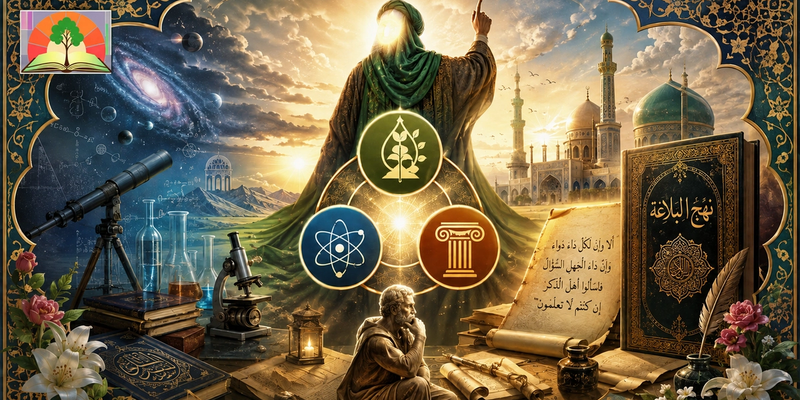
In the previous article, we were very bold. We thoughtlessly asked questions from history and mistakenly asked questions that seem to be against science. While this was not the idea at all. The idea was that the harmony of religion, philosophy and science is the root, branches and fruit of consciousness. Because
- Religion tells us: what is right and what is wrong, what is truth and what is false.
- Without philosophy, there can be no judgment of right and wrong, no recognition of truth and falsehood.
- And after all, without scientific experiments, how can we know why right is right and why wrong is wrong?
Until the intellect is familiar with the contradiction between truth and falsehood, the mind and heart cannot reach the boundaries of contentment. And when the intellect, mind, heart, and contentment resolve truth and falsehood, then certainty arises. Here certainty says: God exists... Here the stages of knowledge of certainty open up for existence. There are two more stages of certainty before it: absolute certainty and true certainty. Finally, existence becomes a "perfect human being" and begins to observe God beyond all veils. Then certainty adorns existence with the robe of divine knowledge and boasts.
The Perfect Being, passing through the final stages of certainty, says:
عَرَفْتُ اللهَ سُبْحَانَهُ بتزک الْعَزَائِمِ، وَحَلِّ الْعُقُودِ، وَنَقْضِ الْهِمَمِ
Translation: I have come to know Allah (swt) through the breaking of intentions, the breaking of promises, and the weakening of courage.
Iradon ki shikaston par sana khwani se pehchaana
Khudaya maine tujhko kitni aasani se pehchaana
(Kalim Haider Sharar)
Let's talk a little bit about the questions while staying on topic. We asked a question...
Is it possible for every human being to be a scientist, intelligent, and understanding?
The real problem is not that everyone knows everything, that is why a doctor cannot repair a car, but he can repair human nature, in fact a mechanic can repair a car. The problem here is the limits of knowledge and human capacity. If both the Maulana and the professor are asked about the periodic table and the theory of relativity, the professor's statements will be more reliable to some extent than the Maulana's. Neither the mechanic's knowledge is useless, nor the doctor's, and neither of them is useful in the scope of either field.
A fundamental caveat is necessary here. Science has made an extraordinary increase in our knowledge of the universe, matter, life, and the human body. Modern medicine, astronomy, physics, chemistry, biology, and technology are clear examples of this achievement. Biological evolution is also a fundamental concept of modern biological sciences and is strongly supported by evidence from various fields. But still, the discoveries of science are not final but rather progressive, which is a positive aspect.
Let me repeat the question again. Is it necessary to know hydraulics to extract water from a well?
Are the discoveries made by science definitive?
The most important thing is that whether he is a scientist or a religious scholar or a philosopher; no one can claim that what he is saying is final. That is why some of the principles of science laid down almost a hundred years ago have changed.
1. Status of Pluto
Old Concept: Before 2006, Pluto was considered the 9th Planet in our solar system and was taught as such in textbooks. Now it is a Dwarf Planet.
2. Dinosaurs
Dinosours were previously considered a genus of cold-blooded lizards, but now, after the discovery of new fossils, they have been moved to the category of winged birds.
3. Neuroplasticity of the human brain
Old Concept: 2006 Old Concept: Until the late 20th century, medical science believed that the human brain only developed during childhood. Research has disproved this theory. Scientists now know that the human brain has the ability to change itself, form new connections, and produce new cells throughout life.
Are injustice and atrocities against humans only part of religious history?
Hiding some things by showing one side of history is a scientific betrayal. Were the 20th century Holocaust, Nazism, Stalin, and Mao Zedong's communist atrocities the result of religious movements? Millions of people were killed in these wars of atheistic and secular ideologies. How much damage did scientific inventions (atomic bomb, chemical weapons) do to humanity? So, oppression is related to human **ignorance and self-interest**, not just to religion.
Just look at this page: Encyclopedia of Wars by Charles Philip and Alan Axelrode, or read RJ Rommel's Death by Government. and decide for yourself. In terms of proportion, the loss of human life in religious wars is less than 4%. Now, let those four knights mix religion and violence as much as they want, history is history.
Suppose God does not exist, and similarly, if God does exist, what would be the harm?
In response to this objection, reviewing the answers of the Imams of the Ahlul Bayt will significantly increase our knowledge and certainty. Therefore, we move forward, ignoring things like Pascal's Wager .
Can natural selection, the keys to physics, astronomy, and chemistry, be challenged?
Mr. Richard Dawkins, you have accomplished a commendable feat, but you should not just boast, not be arrogant. The laws of nature themselves are proof that there is a lawgiver. A designer, a creator, an originator. The orderly system of the universe reveals a powerful and wise Creator.
Here is a suggestion for you: watch Robin Collin's talk, titled Fine -Tuning.
Or look at this dialogue, written by a man who used to be an atheist himself, his name is Anthony Flew, the book is: "There is a God"
There is a God: How the World's Most Notorious Atheist Changed His Mind
Now that I have considered these questions and their answers, the facts have become clear and I have remembered that quote from Socrates.
"I only know that I know nothing"
I know one thing, that I know nothing
Then what am I and what is my knowledge, what is the importance of my recognition of the truth and my observation is also limited, my knowledge is poor, my remedy and belief are far from the facts. I am ashamed to talk about the existence of God.
This is the title that is worthy of the one who is a witness and has been included in the testimony of the one who can say that
ولكِن وَجَدتُكَ أهلًا لِلعِبادَةِ فَعَبَدتُك
Translation: I found you worthy of worship, therefore I worship you.
Bihar al-Anwar: Allamah Majlisi, Volume 41, Page 14
Sharh Nahj al-Balagha: Ibn Abi al-Hadid, Mu'tazilite
اَلْحَمْدُ لِلّٰهِ الَّذِیْ لَا یَبْلُغُ مِدْحَتَهُ الْقَآئِلُوْنَ، وَ لَا یُحْصِیْ نَعْمَآئَهُ الْعَادُّوْنَ وَ لَا یُؤَدِّیْ حَقَّهٗ الْمُجْتَهِدُوْنَ، الَّذِیْ لَا یُدْرِكُهٗ بُعْدُ الْهِمَمِ، وَ لَا یَنَالُهٗ غَوْصُ الْفِطَنِ، الَّذِیْ لَیْسَ لِصِفَتِهٖ حَدٌّ مَّحْدُوْدٌ، وَ لَا نَعْتٌ مَّوْجُوْدٌ، وَ لَا وَقْتٌ مَّعْدُوْدٌ،وَ لَاۤ اَجَلٌ مَّمْدُوْدٌ.
Translation:
All praise is due to Allah, Whose praises are beyond the reach of those who speak, Whose blessings are beyond the reach of those who count, Nor can those who strive do Him justice, Nor can lofty ambitions attain Him, Nor can the depths of intellect and understanding reach His depths. There is no limit to His perfection, Nor are there any descriptive words for Him, Nor is there any time for Him (the beginning) that can be counted, Nor is there any period for Him that can end somewhere.
Nahjul Balagha - Sermon 1 (Urdu)
Nehjul Balagha: Sermon 1 (English)
Written by Syed Minhal (Ibne Sharar)