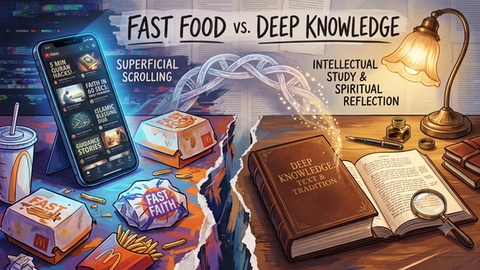

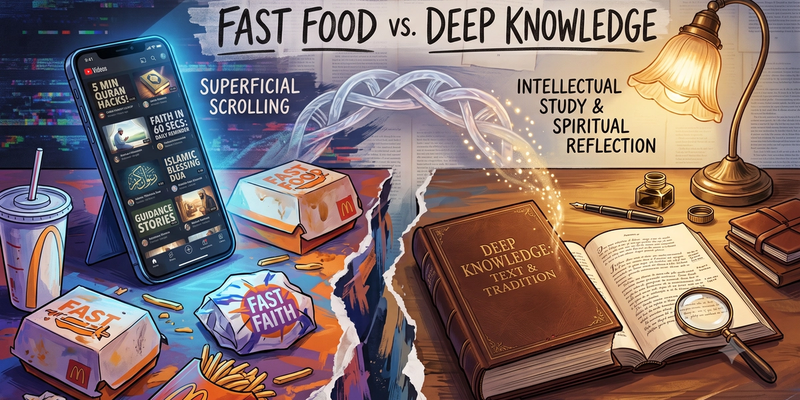
We live in an age where speed is no longer just a part of life; it has become the defining temperament of life itself.
A message is sent, and the reply arrives instantly. An event occurs, and within moments, it reaches mobile screens across the world. A question crosses the mind, and searching a few keywords uncovers a mountain of information. Technology has afforded humanity countless conveniences: it has collapsed distances, saved time, simplified access to knowledge, and revolutionized communication.
The problem is not speed itself.
The problem arises when speed becomes a mental habit, conditioning us to demand instant results from everything.
We begin to expect that everything should be understood in seconds: that history can be encapsulated in a short clip, that philosophy can be reduced to a few sentences, and that profound religious concepts can be mastered within a 30-second video.
This raises a fundamental question: Is everything obtained quickly truly beneficial for us?
The answer can be found on our dining tables.
Consider a familiar sight in modern households: while the kitchen gathers dust, fast food takes over the home. Fast food offers an immediate burst of flavor, but offers no guarantee of healthy digestion.
In urban life today, burgers, sandwiches, pizzas, and shawarmas have woven themselves into everyday culture. Their appeal is easy to understand: attractive packaging, inviting aromas, appealing flavors, instant availability, and liberation from waiting.
The primary promise of fast food is simple: "You are hungry now; you will eat now."
Yet bodily health is not so straightforward. What is prepared in minutes is not necessarily the best fuel for the human body. Nutritional value cannot be judged by packaging, aroma, color, or taste; it must be assessed through its ingredients, portions, method of preparation, and the cumulative effects of long-term consumption.
A burger may look appetizing, a pizza visually tempting, and a shawarma delicious; but aesthetic appeal and nutritional substance are not the same thing.
This very distinction must be applied to the realm of faith.
Today, we face an overwhelming proliferation of "religious fast food."
A few seconds of video, an emotional one-liner, an aesthetic quote, a brief fragment of a verse or tradition, an evocative voiceover in the background—and within moments, a complete "religious message" is served.
Such content can occasionally be useful. Yet the question remains: Can bite-sized religious snippets ever serve as a complete diet for spiritual understanding and intellect?
Certainly not.
Just as the body requires balanced nutrition rather than mere flavor, the mind and soul demand logic, intellectual depth, comprehensive study, and contemplation rather than superficial emotional stimulation.
A Generation Raised in the Glow of the Screen
Today's youth have grown up in a world where the smartphone is not merely a tool for communication. It is their gateway to information, entertainment, education, social relationships, and, to a large extent, their intellectual universe.
Within a single moment, they navigate across ten different subjects:
- A breaking news headline
- A comedy sketch
- A lecture by a religious scholar
- A commercial advertisement
- An account of a historical event
- A philosophical aphorism
Within seconds, the topic shifts entirely.
This perpetual velocity inevitably fragments human attention. Modern audiences often demand that the core point be delivered instantly.
This preference is not blameworthy in itself; after all, we designed these communication mediums to function this way.
The crisis begins when an individual assumes that whatever cannot be understood in a short span of time is simply unimportant.
Reality is often quite the opposite.
Some matters are brief because they are fundamentally simple; other matters are lengthy because reality is inherently complex.
Foundational questions concerning justice, freedom, morality, God, humanity, prophethood, leadership, the afterlife, history, and civilization cannot be reduced to a few catchphrases simply because our time is limited.
A shortage of time does not simplify the nature of truth.
Brevity is not a flaw; incompleteness is.
Brevity Versus Superficiality
A crucial distinction must be recognized here: brief religious discourse is not only possible, but often necessary.
- A well-crafted sentence can provoke profound thought.
- A short video can dismantle a widespread misconception.
- A single verse can awaken a dormant conscience.
- A pointed question can launch a seeker on years of rigorous study.
Therefore, our grievance should not be with brevity itself; our opposition must be against superficiality.
The purpose of concise expression is not to amputate a complex truth until the essence of the reality vanishes entirely.
True skill lies in ensuring that:
- The discourse is brief, yet orderly;
- It is simple, yet not shallow;
- It is engaging, yet grounded in evidence.
A "religious sandwich" is assembled quickly, but it creates intellectual indigestion. Historical detail is discarded, the background of arguments is erased, differing viewpoints are ignored, and context disappears entirely.
A couple of emotive phrases are placed in the middle, garnished with an isolated verse or tradition on top, and packaged into a slick, seconds-long presentation.
The religious sandwich is ready!
It may appear appealing, but the scholarly dilemma persists: Does it retain the vital context without which the true meaning is distorted?
Here we must pause. In religious knowledge, even a minor omission can result in massive semantic distortions.
The Allure of the Pizza Versus the Reality of Knowledge
Social media conditions us to believe that whatever commands the most attention is the most successful.
This creates a dangerous rift between genuine knowledge and mere popularity.
An attractive photograph of a pizza stimulates the appetite, but a photograph provides zero nourishment.
Similarly, pristine video editing, elegant calligraphy, a passionate delivery, and an emotional tone do not prove that an intellectual claim is sound and complete.
Presentation captures attention; evidence builds conviction. In matters of faith, the distinction between the two must remain absolute.
Do Not Wrap Everything into a Shawarma
Attempting to pack theology, history, jurisprudence, politics, ethics, and philosophy into a single short video yields a result akin to stuffing discordant flavors into a single shawarma wrap.
The listener is left unable to discern:
- What is definitive versus speculative?
- What is an established narration versus historical commentary?
- What is scholarly consensus versus a speaker's personal deduction?
A fundamental hallmark of genuine knowledge is categorization and discernment. When everything is flattened onto a single plane, information may increase, but true comprehension is lost.
What to Do with Short Religious Content
Our strategy must be deliberate and clear: rather than attempting to pull young people away from social media, we must guide them from social media toward substantive reading.
- Produce short videos, but ground them in comprehensive discussions.
- Provide an insightful quote, but cite the source text.
- Raise an intriguing question, but provide the resources necessary to explore it.
- Cite a tradition, but include its original reference wherever possible.
In short, build bridges:
- From the clip to the book;
- From the question to research;
- From momentary attention to sustained study;
- From raw information to profound wisdom (ma'rifah).
This is the threshold where modern media ceases to be a liability for religion and becomes an effective vehicle for it.
Traditional Preaching and Modern Formats
The classical Islamic scholarly tradition recognized that a single message cannot be delivered to every audience in the exact same manner.
Demonstrative proof (burhan), dialectic (jadal), and rhetoric (khatabah) each occupied distinct spheres. The audience's capacity, the objective of the dialogue, and the nature of the argument were always taken into account.
Today, a 30-second video does not need to serve as a substitute for an exhaustive theological or philosophical treatise.
Its proper function is merely to open the door.
And that is sufficient:
- If a young person watches a 30-second video and develops a serious, probing question, the video has succeeded.
- If that question leads them to an essay, that is a greater success.
- If the essay directs them to a book, the medium has fulfilled its true potential.
- If that book inspires reflection, inquiry, and personal transformation, the brief message has realized its highest purpose.
What Must We Offer Today’s Youth?
We must not simply hand young people ready-made answers; we must teach them how to ask meaningful questions.
We must not merely provide them with information; we must train them to trace primary sources.
We must not solely demand that they listen to our views; we must teach them to weigh competing arguments with discernment.
We should not condition them to form instantaneous opinions on every complex topic. Instead, we must teach them that responding with, "I do not know yet; I need to read further on this," is itself a valid, intellectually mature answer.
Such a statement is not an admission of weakness; it is the hallmark of intellectual integrity.
The Mind Needs a Balanced Diet
The fundamental hazard of fast food is not the occasional burger or pizza—it becomes harmful when an occasional indulgence turns into a permanent diet.
Similarly, brief religious content has a legitimate place. The crisis emerges when bite-sized material becomes the sole source of religious sustenance.
Therefore, our message to today's youth should not be to discard smartphones, abandon social media, or avoid short videos entirely.
Rather, we must teach them to:
- Watch, but with critical discernment;
- Listen, but with deliberate thought;
- Read, but verify the sources;
- Accept, but only through sound reasoning;
- And never shy away from dedicating time to topics of profound depth.
To scholars, teachers, and communicators, the appeal is equally clear: understand the pace of youth, but do not sacrifice the depth of knowledge. Speak their language, but do not compromise the integrity of truth. Capture their attention, but do not make them captive to your personality—lead them onward to books, rigorous thought, and critical inquiry.
Do not reduce religion to content that merely stops an endless scroll; fashion a message that causes an individual to pause their life and truly reflect.
A burger can be cooked in minutes, a pizza delivered in moments, and a shawarma handed over instantly—yet a human being cannot attain wisdom in seconds.
Wisdom requires time, deep study, honest questioning, contemplative silence, and the courage to step outside one’s own preconceived notions.
Our ambition must not be to perpetually feed the youth on religious fast food alone. Our objective must be to offer an appetizing first bite that leads them to a banquet furnished with books, evidence, critical questions, and complete spiritual nourishment.
Let the journey begin with a concise message—but let it not end there.
May the gaze lift from the screen, settle upon the page, spark an inquiry in the mind, awaken a yearning in the heart, and set the human being upon the path of true understanding.
This represents both the greatest challenge and the most promising opportunity in religious communication for the youth of today.