
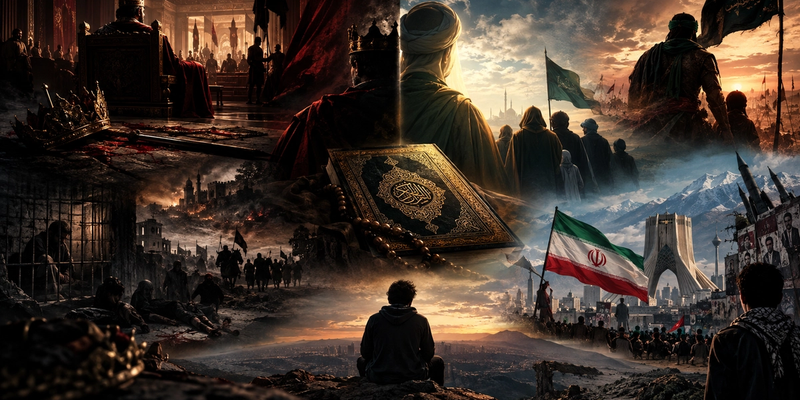
If the history of Muslims after the passing of the Holy Prophet (peace and blessings be upon him and his family) is examined not through the lens of reverence, but with the clear gaze of justice, an inescapable and bitter truth emerges. A vast portion of the Ummah’s political history appears stained by the lust for power, monarchy, tyranny, despotism, conspiracy, bloodshed, imprisonment, and political vendetta. Thrones changed hands, crowns shifted from head to head, dynasties overthrew one another, and empires rose and fell; yet the hunger for authority repeatedly trampled justice, and raw might consistently sought to suppress the voice of truth.
In the pursuit of the throne, brother spilled the blood of brother; to preserve authority, voices were silenced; champions of truth were left to languish in dungeons, and the sword replaced reasoned discourse. The very faith that came to deliver humanity from oppression toward justice was cloaked in sacred rhetoric by rulers to legitimize their rule. Thus, unconditional loyalty was demanded of the subjects, while any question of accountability for the rulers was buried.
On the front pages of history wave the banners of conquest, but turn the leaves and behind them stand blood, chains, burned homes, silent graveyards, and countless nameless victims. The palaces endure, yet the screams buried in their foundations were largely muffled by the pen of the victor.
Therefore, reading history solely through the eyes of the conqueror is not reading history; it is merely reading the victor’s narrative. History is complete only when the prison cell is seen alongside the throne, when the corpses are counted alongside the triumph, when the severed head of the oppressed is witnessed alongside the crown, and when the cry of the human soul crushed by an imperial edict is heard alongside the edict itself.
For not every victor stands on truth, not every defeated soul represents falsehood, and not beneath every crown does justice reside.
The true test of history is not how much territory one conquered; the essential question is who paid the price for that conquest, whose blood was spilled, whose freedom was stripped away, and whose voice was silenced forever.
Yet, this is not the whole of the Ummah’s history.
The Holy Prophet (peace and blessings be upon him and his family) had already charted the path to deliver his followers from this darkness. The Hadith of Thaqalayn (The Two Weighty Things) stands as the foundational declaration of this path. He designated the Holy Qur'an and his purified Ahl al-Bayt (peace be upon them) as two invaluable trusts for the Ummah, binding adherence to them with the continuation of true guidance.
The meaning of this decree is not merely to recite the Qur'an and harbor affection for the Ahl al-Bayt; rather, it conceals a profound responsibility: that the Qur'an must be made the epicenter of guidance, and the Ahl al-Bayt (peace be upon them) must be embraced as the living models of its understanding, its ethics, and its practical application. The Qur'an is the destination of guidance, and the Ahl al-Bayt are its living embodiments—one is the Book, and the other is the purified household inextricably tied to that Book, demonstrating its teachings through exemplary character.
This is the very juncture where the two paths of history diverge.
One path led toward raw power, where religion served alternately as the justification for empire and as an instrument to protect the throne. The other path led toward the Thaqalayn, where justice was drawn from the Qur'an and steadfastness from the Ahl al-Bayt; where knowledge was derived from the Qur'an and action from the Ahl al-Bayt; where piety was anchored in the Qur'an and self-sacrifice was learned from the living conduct of the Ahl al-Bayt.
The legacy of those who walked this second path is not written in crowns and thrones, but in knowledge, righteous action, patience, struggle, selflessness, imprisonment, and martyrdom. They received little of political dominion and much of trial, yet they never sacrificed principle for political expediency. Karbala stands as the most radiant and decisive manifestation of this worldview, where Imam Hussain (peace be upon him) offered his life and the lives of his loved ones to demonstrate that living by the soul of the Qur'an means never remaining silent before oppression.
Therefore, if any chapter in the history of Muslims can truly be called exemplary, it is found not in the palaces of monarchs, but in the lives of those righteous souls who took the Qur'an as their guide, the Ahl al-Bayt (peace be upon them) as their practical exemplars, and justice and truth as the standard of their existence.
If one seeks to observe this historical continuum in the modern era, contemporary Iran presents an important case study.
Following the 1979 Revolution, Iran aligned its state identity with the principles of Islam, sovereignty, and liberation from foreign hegemony. Despite relentless pressure from global powers, it sought to formulate its political decisions in accordance with its ideological and national priorities. Along this journey, it has endured war, economic sanctions, sustained financial pressure, and chronic geopolitical confrontation. The Iranian leadership views these conditions as the necessary cost of sovereignty and resistance, whereas critics point to the severe domestic and external consequences of these policies. Consequently, Iran must be evaluated not through raw sentiment, but in the sober light of its actions, its history, and its outcomes.
Nevertheless, the Iranian experience brings a fundamental question to the fore: Can a Muslim nation preserve its ideological identity, political sovereignty, and autonomous decision-making in the face of immense pressure from global superpowers? Iran, on a practical plane, has sought to forge its own answer to this question.
Perhaps the ultimate lesson of history is this: empires may be erected through force, but what endures across the ages are principles and sacrifices. Thrones crumble, crowns fall, and rulers pass away; but the character that stands firm for truth only grows more luminous with the passage of time.
History, in the end, does not ask how much power you held; it asks where you stood with the truth in an age of power, terror, and oppression.

