

Certain events in history are not merely tales of the past; they transform into living inquiries whose echoes continue to awaken the human conscience centuries later. The significance of such events lies not only in what transpired, but in why it occurred, who the central figures were, what consequences followed, and what historical records preserved regarding them. The life, grievances, and martyrdom of Lady Fatima al-Zahra (peace be upon her) following the demise of the Messenger of Allah (peace and blessings be upon him and his family) constitute one of the most sensitive, consequential, and critical chapters of Islamic history—a chapter demanding an understanding of historical testimonies, textual narrations, and contextual linkages alongside emotional reflection.
What circumstances enveloped the life of the beloved daughter of the Prophet (pbuh) in sorrow and affliction? What transpired regarding Fadak and the inheritance of the Messenger of Allah (pbuh) that preserved the testimony of Lady Fatima's displeasure within the most authentic Sunni hadith compendia, despite numerous interpretive apologetics and justifications? Why does a canonical authority such as Sahih al-Bukhari explicitly record this displeasure and her refusal to speak with the authorities until her passing? What explanations are offered to diminish the gravity of this historical fact? Can an event documented in mainstream history be obscured beneath interpretive coverings, or is it an inquiry that must be confronted with historical integrity and academic impartiality? What accounts and traditions surround the background of her demise mere months after the Prophet's passing? How did divergent historical interpretations of these events shape the subsequent trajectory of Islamic history?
These are not merely academic inquiries; they pertain to the life of an individual whom the Prophet (pbuh) loved exceptionally, whose pleasure and displeasure he tied directly to his own, and whose departure plunged Imam Ali (as), al-Hasan (as), al-Husayn (as), and the entire Household of Prophethood into profound grief. Approaching this subject requires that vital historical questions are not eclipsed by sentiment, that traditions are scrutinized with rigor rather than assumed blindly, and that established historical evidence is not minimized through apologetic rationalizations. Let us examine this poignant chapter in the light of traditions, historical testimonies, and intellectual honesty—perhaps these realities will not only evoke grief, but also urge us to reflect upon questions that remain an enduring test for human understanding and conscience.
The Bond of Unconditional Prophetic Love
The Messenger of Allah (pbuh) held extraordinary love for his daughter, Fatima al-Zahra (sa). Aisha bint Abi Bakr narrated that she did not see anyone resemble the Messenger of Allah (pbuh) more closely in manners, conduct, carriage, and speech than Fatima (sa). Whenever she entered his presence, the Prophet (pbuh) would stand up to welcome her, take her hand, kiss it, and seat her in his own place.
(References: Sunan Abi Dawud, Kitab al-Adab, Hadith 5217; Jami` at-Tirmidhi, Kitab al-Manaqib, Hadith 3872)
Reflect upon the depth of this bond: a father whose arrival brightened his daughter's home, and a daughter upon whose entrance the Prophet of God arose out of veneration. When the veil of mortality separated them, what immense sorrow must have weighed upon her heart?
The demise of the Prophet (pbuh) was not merely the loss of a revered leader; for Fatima (sa), it meant separation from the father who was the source of her deepest serenity. Gone was that affectionate hand, that soothing voice, and that luminous countenance that brought tranquility to her heart. The alleys of Medina remained unchanged and the walls of her home stood firm, yet the greatest joy of that household had departed.
Consider the depth of her grief when the Prophet (pbuh) disclosed a secret to her shortly before his passing. According to Aisha's narration, the Prophet (pbuh) first whispered to her that he would succumb to this illness, causing Fatima (sa) to weep profusely. He then whispered that she would be the first of his household to join him, at which she smiled.
(References: Sahih al-Bukhari, Kitab Fada'il Ashab al-Nabi, Hadith 3623; Sahih Muslim, Kitab Fada'il al-Sahabah, Hadith 2450)
This narration illustrates a daughter's singular love and the solace she derived from the promise of an early reunion with her father. Yet it raises a haunting inquiry whose only response is tears: did anyone contemplate what trials Fatima (sa) would endure in the brief time following her father's departure?
When Grief Was Compounded by Injustice
To reduce the trials faced by Lady Fatima al-Zahra (sa) after the passing of the Prophet (pbuh) to mere "sectarian divergence" is to overlook the essence of the historical matter. Apologetic narratives often seek to dilute the weight of her grievances through reinterpretation, rationalization, and excuses. Nevertheless, the premier Sunni hadith source, Sahih al-Bukhari, explicitly records her anger regarding the issue of Fadak and the prophetic inheritance following the decision of Abu Bakr, as well as her refusal to speak with him until her death. This historical testimony demonstrates that following the Prophet's demise, his beloved daughter faced deep distress, sorrow, and significant discord over her legitimate rights.
When such accounts are preserved within authentic historical sources, why should they be met with forced justifications that minimize her displeasure? Was the heartbreak of the daughter of the Prophet (pbuh) a trivial disagreement, or an event demanding serious, objective, and equitable evaluation? Concealing historical realities behind interpretive screens neither alters the truth nor silences the enduring cry of the oppressed.
It is recorded in Sahih al-Bukhari from Aisha that Lady Fatima (sa) claimed her share of the inheritance left by the Messenger of Allah (pbuh) from Abu Bakr, but he refused on the basis of a narration attributed to the Prophet (pbuh). Consequently, Fatima (sa) became displeased and did not speak to him for the remainder of her life. The narration further mentions that she survived the Prophet (pbuh) by only six months.
(References: Sahih al-Bukhari, Kitab Fard al-Khumus, Hadith 3092; Kitab al-Maghazi, Hadith 4240–4241)
Regardless of how many layers of rationalization are constructed over these narratives, one undeniable historical fact remains: following the passing of the Prophet (pbuh), Lady Fatima al-Zahra (sa) endured severe distress, emotional trauma, and bitter disputes concerning her rights. The explicit text of Sahih al-Bukhari attests that she departed this world estranged and displeased over these decisions. This is not the fabrication of later chroniclers, but an established report found in the core classical corpus.
Consider the gravity of this circumstance: while the wound of her father's departure was still raw and unhealed, his beloved daughter was subjected to dispute and deprivation regarding her rights. The very lady for whom the Prophet (pbuh) would stand out of reverence, and whom he declared to be an intrinsic part of himself, had her profound anguish etched into the annals of history. The inquiry is not merely how to interpret this grief, but why the causes and accountability behind her sorrow are so seldom addressed with academic seriousness.
Inside that humble home where Ali (as) and Fatima (sa) shared their lives, where the innocent voices of al-Hasan (as) and al-Husayn (as) once echoed, and where Zaynab (sa) and Umm Kulthum (sa) were nurtured, lengthening shadows of parting gathered. Did anyone consider the hearts of those young children? What did they feel seeing tears in their mother's eyes? When silence overtook her, who answered their tender inquiries? And when she embraced them, did she not carry the heartbreaking realization that her days among them were drawing swiftly to a close? These questions do not displace historical records; they uncover the human suffering borne by a grieving family.
The Patience of Ali (as) and the Final Parting
The martyrdom and sorrow of Lady Fatima al-Zahra (sa) cannot be understood without the figure of Imam Ali (as). Ali (as), the Prophet's designated trustee (Wasi) and closest companion—who bore the fierce tribulations of early Islam and demonstrated unmatched valor on the battlefield—faced an agonizing trial against which physical strength offered no remedy.
Battle wounds may be dressed and sword strikes may heal, but what heals the wound of losing one's lifelong companion? When the one with whom you shared life's trials and triumphs, built a home, and raised children departs forever, every corner of the house becomes an aching memory: the doorway, the courtyard, the resting mat, the voices of the children, and the simple routines of everyday life. To Ali (as), Fatima (sa) was not merely a wife; she was the living legacy of the Messenger of Allah (pbuh), the mother of his noble lineage, and the supreme confidante of his life.
Envision the moments when Imam al-Hasan (as) and Imam al-Husayn (as) sat beside their fading mother. For young children, a mother’s presence is their supreme sanctuary—her hand, her voice, her prayers, and her embrace are their safest refuge. When that mother departs, an irreplaceable void opens within their universe. Was it easy for al-Hasan (as) and al-Husayn (as) to bid their mother a final farewell? Was it possible for young Zaynab (sa) to grasp the gravity of this eternal separation in silence? These inquiries speak directly to the core of the human soul.
The Night She Departed
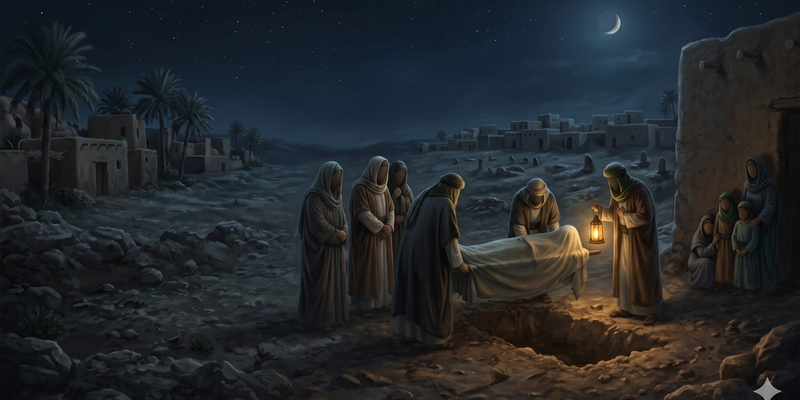
Historical records document varying perspectives on the timeline of Lady Fatima's (sa) demise and burial. As recorded in Sahih al-Bukhari, she survived the Prophet (pbuh) by six months. Her martyrdom, the injustices she suffered, and her subsequent nighttime burial remain among the most somber chapters of Islamic history. According to authenticated historical accounts, she was laid to rest in secret during the dead of night, and her gravesite was deliberately concealed—a lasting testament to her grievances etched into the collective memory of history.
Picture this scene through the eyes of the heart: the beloved daughter of the Messenger of Allah (pbuh) has departed this mortal world, and Imam Ali (as) prepares to accompany his cherished companion to her final resting place. The home once graced by the presence of the Prophet (pbuh) sank into a silence beyond the reach of words.
Upon returning to that desolate home, every remnant spoke of her absence. The young children searched for their mother—one yearning for her embrace, another for the sound of her voice, another for the gentleness of her touch. Yet they stood before an unyielding reality that no words of comfort could alter. A house remains standing when a mother passes away, but its soul departs with her. When that mother is Fatima al-Zahra (sa)—whose home was perfumed with the love of the Prophet (pbuh) and the divine sanctity of the Ahl al-Bayt (as)—the contemplation of her absence shakes the spirit.
With what forbearance must Ali (as) have endured this crushing loss! Before him stood grieving children, an empty home, and heavy obligations, while within his chest lay a sorrow beyond verbal expression. Did his gaze not wander into the night toward the quiet corner where Fatima (sa) used to sit in prayer? Did the voices of the orphaned children not revive the ache of their mother's memory? Did the grief of losing the Messenger of Allah (pbuh) not deepen tenfold after the departure of Fatima (sa)? It is at this juncture that historical inquiry transforms into profound empathy, placing the seeker within the lived reality of those events.
Her Legacy: An Enduring Responsibility
Remembering Lady Fatima al-Zahra (sa) is not confined to lamentation alone; it is a commitment to truth, justice, purity, steadfast patience, and human dignity. Her life instructs us never to compromise divine principles in the pursuit of justice, never to surrender patience in times of calamity, and to manifest genuine love for the Prophet (pbuh) and his Household (as) through upright character and action.
For people of faith, this remains an immense tragedy. To reflect upon the final months of the Prophet's beloved daughter is to be overtaken by sorrow: a daughter who lost her noble father, a lady who withstood grief and denial of her rights, a mother who parted from her young children, and a wife whose absence cast an enduring pall of grief over the home of Ali (as).
Peace be upon you, O daughter of the Messenger of Allah!
Peace be upon your purified life, your steadfast patience, your devoted worship, and your memory that continues to fill millions of hearts with reverence, love, and grief.
O Lady Fatima al-Zahra (sa)! When your father departed this world, your heart was laden with sorrow; then you too departed, leaving behind an immortal legacy. Even today, whenever your name is invoked, waves of grief stir the hearts of the faithful, tears well up, and the mind ponders the immense sacrifices rendered by the Ahl al-Bayt (as) throughout the history of Islam.
O Lord! Bestow upon us the true recognition (ma'rifah) of Lady Fatima al-Zahra (sa); grant us the ability to walk upon her path; grant us hearts that comprehend her grief; and make the love of the Messenger of Allah (pbuh) and his purified Household (as) an inseparable pillar of our faith, character, and conduct.
Peace be upon you, O Mistress of the Women of the Worlds, O Fatima al-Zahra (sa).
