
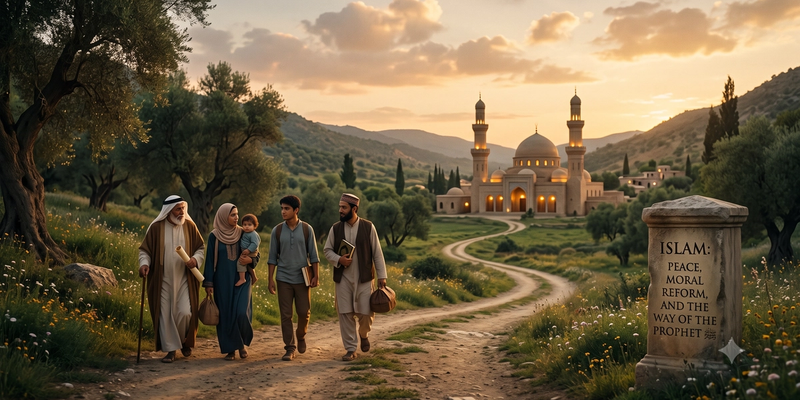
To truly understand Islam, the primary question should not be how much territory Muslims conquered throughout history, but rather: for what purpose was the Prophet Muhammad ﷺ sent?
When we seek the answer from the Quran, we find no indication that he was commissioned to conquer nations, dismantle foreign governments, or establish a global Muslim empire. Instead, the Quran defines the Prophet ﷺ as a mercy to the worlds (Rahmatan lil-Alamin), a bearer of glad tidings (Bashir), a warner (Nadhir), and an inviter to God (Da'i ila Allah). In other words, he was sent as a universal mercy, one who brings hope, issues warnings, and invites mankind toward the Divine (Al-Anbiya: 107; Al-Ahzab: 45–46).
The Prophet ﷺ first taught humans mastery over their own desires and egos. The thirteen years in Mecca stand as the greatest testament to this principle. Throughout this entire era, the core message of Islam was not territorial conquest, but the transformation of the human soul: replacing polytheism with monotheism, tyranny with justice, ignorance with knowledge, arrogance with humility, and worldly obsession with accountability in the Hereafter. The Quran consistently highlights the rights of orphans and the impoverished, fair weights and measures, truthfulness, integrity, and personal moral responsibility. Nowhere does it state that the success of Islam is measured by the extent of land Muslims control.
If the primary objective of Islam were empire-building, political power would have been pursued first during the vulnerable Meccan period. Instead, the Quran directed the Prophet ﷺ to proclaim:
"Say, 'I am only a man like you, to whom it has been revealed that your God is One God.'" (Al-Kahf: 110)
Islam’s foundation was the reform of human consciousness and faith, not the construction of an empire.
The Quran also explicitly defined the methodology of calling people to faith:
"Invite to the way of your Lord with wisdom and good counsel." (An-Nahl: 125)
Furthermore, it established a clear principle regarding religious belief:
"There is no compulsion in religion." (Al-Baqarah: 256)
This clearly demonstrates that Islam addresses the human heart and intellect; it never coerces anyone into accepting its creed.
Upon arriving in Medina, the Prophet ﷺ did establish a socio-political order, but its purpose was never mere governance or dominance. Its foundation rested entirely upon justice and human welfare. The Quran states:
"Indeed, Allah orders justice and good conduct." (An-Nahl: 90)
Therefore, the greatness of an Islamic polity must never be evaluated by the number of cities or provinces it ruled, but by the degree of justice, peace, and rights enjoyed by the people under its care.
Regarding warfare, the Quran never granted unchecked permission to fight. Instead, it set precise moral boundaries:
"Fight in the way of Allah those who fight you, but do not transgress limits." (Al-Baqarah: 190)
Here, while warfare is permitted in self-defense, transgression is strictly forbidden. Consequently, not every military campaign in history can be deemed holy or genuinely Islamic simply because Muslims fought in it.
The Quran further instructs:
"And if they incline to peace, then incline to it also." (Al-Anfal: 61)
Islam’s ultimate goal is peace, not conflict. War may arise out of circumstantial necessity, but it can never serve as the foundational mission of Islam.
The Treaty of Hudaybiyyah is a prime example of this principle. The Prophet ﷺ accepted terms that appeared unfavorable and difficult to many Muslims, yet the Quran designated this very accord as a "manifest victory" (Al-Fath: 1). If victory meant only territorial seizure and defeating adversaries on the battlefield, the Quran would never have termed a peace pact a victory. This proves that creating avenues for peace, enabling the peaceful conveyance of truth, and preventing bloodshed are themselves forms of genuine triumph.
The Conquest of Mecca illustrates this even more profoundly. Mecca was the city that drove the Prophet ﷺ out, persecuted his companions, and waged multiple wars against the early community. When the city was finally within his power, a faith driven by raw dominance, vengeance, and imperialism would have turned it into a bloodbath. Instead, the Prophet ﷺ transformed military victory into an act of mercy, reconciliation, and unconditional pardon. This essential distinction separates Islamic victory from conventional imperial conquests.
Two contrasting worldviews emerge here: for an earthly monarch, victory means seizing land, confiscating treasuries, and expanding imperial dominion. For the Prophet of Islam ﷺ, true victory meant the moral elevation of humanity, the transformation of the heart, the perfection of character, and the establishment of justice within society.
Following the departure of the Prophet ﷺ from this world, history took a different turn. The Muslim state expanded rapidly, bringing the Levant, Iraq, Egypt, Persia, North Africa, Central Asia, Sindh, and later Andalusia under Muslim political rule. These are indisputable historical facts. However, a critical question arises: was every conquest carried out by Muslims genuinely a victory for Islam?
This question must be evaluated using the Quran rather than sentimentality.
The Quran never commanded Muslims to conquer foreign lands simply to expand an empire. It never stated that annexing nations is an act of worship in itself. Nor did it measure human dignity by the size of the territory one controls:
"Indeed, the most noble of you in the sight of Allah is the most righteous of you." (Al-Hujurat: 13)
Thus, the political and military campaigns that followed the Prophet's ﷺ era should be examined as historical events. One can debate their underlying causes and evaluate their outcomes, but merely because the participants were Muslims does not make these conquests the religious objective of Islam or spiritual achievements worthy of devotional pride.
Every action taken by a Muslim is not automatically Islamic; Islam is that which is taught by the Quran.
Conflating the two leads to dangerous conclusions: the tyranny of a Muslim monarch would then be labeled "Islamic," his lust for power would be sanctified, every one of his wars would be deemed jihad, and every imperial expansion would be heralded as the exaltation of faith. We would then be deriving our understanding of Islam from the history of kings rather than the guidance of the Quran.
This is precisely where the life and conduct of the Prophet's Household (Ahl al-Bayt, peace be upon them) become critically instructive. Following the demise of the Prophet ﷺ, the Ahl al-Bayt (AS) did not safeguard religion through imperial conquests; rather, they preserved it through the Quran, knowledge, ethics, devotion, justice, patience, sacrifice, and the defense of truth. They measured religious success not by imperial boundaries, but by the integrity of human faith, intellect, and moral character.
The lives of Commander of the Faithful Imam Ali (AS), Imam Hasan (AS), Imam Husayn (AS), and the subsequent Imams of the Ahl al-Bayt (AS) must be studied through this lens. They kept the essence of the faith alive not through the apparatus of monarchical power, but through their personal character, moral clarity, and supreme sacrifice.
