

A question for Muslims:
33 Years vs. 3 Years — Why This Disparity in Narrations?
The traditions (ahadith) of the Messenger of Allah (peace and blessings be upon him and his progeny) constitute an essential treasure of our faith. For this reason, anyone seeking to understand Islamic history must inevitably confront an important question.
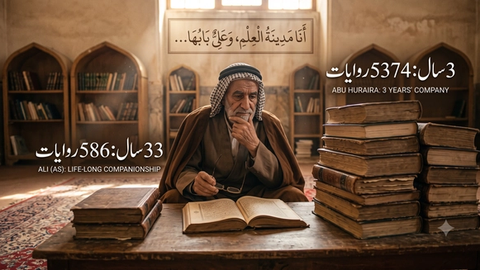
Imam Ali (peace be upon him) opened his eyes under the Prophet’s direct care, spent his childhood alongside him, and was raised through his personal tutelage. He spent approximately 10 years with him before the declaration of Prophethood and roughly 23 years after it until the Prophet’s demise—a lifelong companionship spanning approximately 33 years. There is scarcely any significant milestone in the life of the Messenger of Allah in which Imam Ali did not participate. Yet, according to prominent Sunni compilations, only around 586 traditions are attributed to Imam Ali.
Now, consider Abu Huraira on the other hand. He embraced Islam around 7 AH and remained in the Prophet’s company for only about three years before the Messenger’s passing. Yet, the number of traditions narrated through him stands at 5,374.
The question is straightforward:
How is it that Ali, who spent approximately 33 years alongside the Prophet, has only 586 narrations attributed to him, while someone whose companionship lasted roughly 3 years accounts for 5,374? Why did this disparity arise?
Is this numerical gap a mere coincidence? Or must we uncover the silent pages of history where it was perhaps decided how much access the Muslim community would have to Ali, the "Gate of Knowledge"? Could it be that the gateway to knowledge stood right before us, yet at some historical juncture, the path to reaching that door was restricted?
All this stands alongside the renowned declaration of the Messenger of God:
"I am the city of knowledge, and Ali is its gate; whoever seeks the city must enter through its gate."
Reference: Al-Hakim al-Nishapuri, Al-Mustadrak 'ala al-Sahihayn, Book of the Knowledge of the Companions, Vol. 3, p. 137, Hadith 4637.
If all of this was mere chance, the inquiry becomes all the more critical:
586 traditions from 33 years of companionship versus 5,374 from nearly 3 years—does history not permit us to seek a clear explanation for this extraordinary contrast?
This is neither an insult nor an accusation against anyone. It is merely a question—yet one that compels us to re-examine our history, our corpus of hadith, and the channels through which the Prophet’s knowledge was transmitted.
O Islamic world, pause and reflect for a moment...
This is not simply a matter of 586 versus 5,374. It is a fundamental question of which path the community took to inherit the Prophet’s wisdom—and from which path it remained deprived.
If Ali, the Gate of Knowledge, stood right before us, why was our access to that gateway so severely restricted?
Was this purely coincidental, or was the path of transmission deliberately rerouted at a turning point in history?
O Islamic world, do not look at the figures alone; examine the history concealed behind them.
Then judge for yourselves:
Is this merely a difference in the volume of narrations, or a reflection of the history behind the transmission itself?