

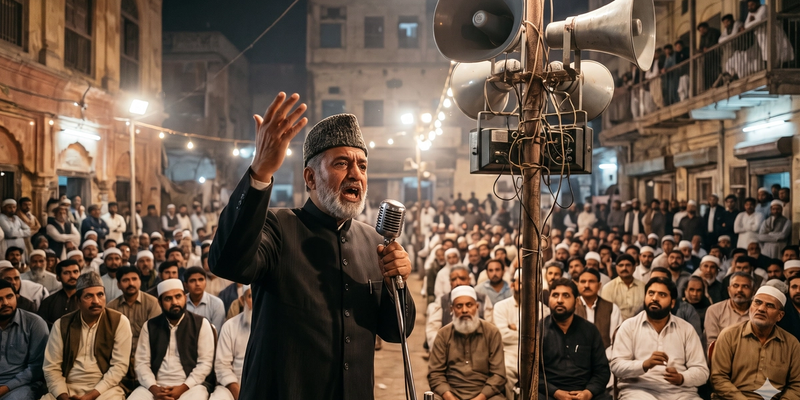
There was once a time when gatherings and congregations lacked modern acoustic conveniences like microphones. Orators and speakers had to raise their voices significantly to project their words to the farthest corners of the gathering. Given the sheer size of the audience and the physical distance, this was a natural necessity so that every person present could hear the discourse and benefit from it. In those days, vocal loudness was a functional demand of oratory, not merely a stylistic affectation or a display of theatrical passion.
Today, however, times have fundamentally changed. Modern sound technology has made voice transmission effortless. Through a decent microphone and sound system, even a gentle, measured tone can reach an entire gathering with complete clarity. Despite this, an ironic situation has emerged: while audience sizes often dwindle, the volume, shouting, and noise produced by certain speakers and preachers continue to escalate. It is as though the invention of the microphone, instead of providing ease, has merely institutionalized a new culture of screaming.
The true beauty of eloquence does not lie in how loudly a person speaks, but in the merit of what is said and the elegance with which it is delivered. Shouting may momentarily grab an audience’s attention, but touching human hearts demands knowledge, rigorous study, cogent reasoning, and conversational grace. Refined oratory is that in which the weight of the argument surpasses the volume of the voice.
Articulating the fundamental principle of conveying guidance, the Holy Qur'an states:
“Invite to the way of your Lord with wisdom and good instruction…”
— (Surah An-Nahl: 125)
Reflect upon this: the Almighty made wisdom and sound counsel the benchmark of invitation, not vocal amplification. Similarly, the Qur'an records the counsel of Luqman to his son:
“And lower your voice; indeed, the most disagreeable of sounds is the braying of donkeys.”
— (Surah Luqman: 19)
This verse instructs us in dignity, moderation, and refinement in speech. This does not imply that raising one's voice is forbidden under every circumstance, but rather that vocal projection must align with the context, necessity, and objective.
The Messenger of Allah (peace and blessings be upon him and his progeny) stated:
“Gentleness is not found in anything except that it beautifies it, and it is not removed from anything except that it disgraces it.”
This principle applies directly to public speaking and religious discourse.
An oratorical style built on screeching and clamor is not only grating, off-putting, and at times comical to the ears, but it also degrades the sanctity and solemnity of the gathering. Furthermore, its disruption is not confined to the hall; it encroaches upon the peace of nearby residents and neighbors. On the speaker’s end, habitual shouting exerts unnatural strain on the vocal cords, risking vocal fatigue, throat disorders, cardiac strain, and other medical complications.
It is vital that oratory balances passion with prudence, fervor with restraint, and sound with dignity. In the presence of modern acoustic technology, equating shouting with rhetorical impact is neither intellectually defensible nor compatible with public decorum and personal well-being.
We must recognize that the objective of a congregation is not to batter the ears of the audience with excessive noise, but to awaken intellects to reflection, hearts to awareness, and character to reform. A speaker’s success is measured not by how loud their voice was, but by how deeply their message penetrated and how many hearts embraced it.
It is imperative that we critically re-evaluate the standards and aesthetics of public speaking. When efficient means of audio transmission exist, screaming serves no purpose. A speaker should be distinguished not by vocal intensity, but by depth of knowledge, intellectual maturity, eloquence, and the resonance of their message.
Remember: a loud voice may stun a crowd into temporary silence, but inspiring the human heart requires knowledge, intellectual depth, the gentleness of wisdom, and the force of reason. The ultimate mastery of eloquence lies not in high volume, but in the profound impact of thought.
