In the name of Allah, the Most Gracious, the Most Merciful.
Peace be upon you, O Son of al-Zahra (may Allah hasten his noble reappearance).
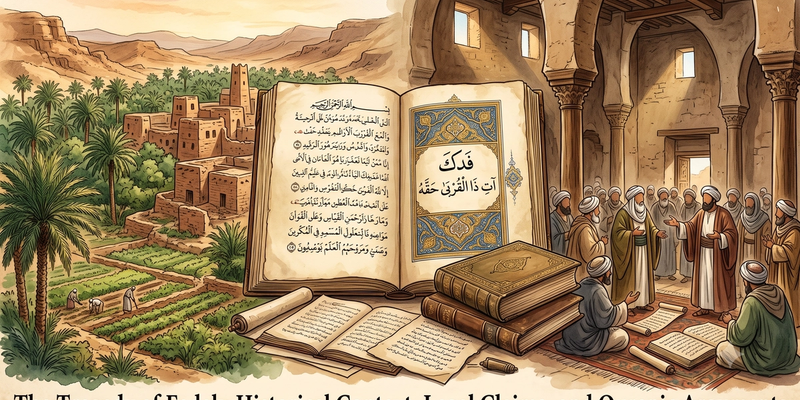
The sorrowful chronicle of Fadak represents a pivotal juncture in Islamic history. What were the underlying factors that caused the beloved daughter of the Prophet Muhammad (peace and blessings be upon him and his family)—the very embodiment of the Verse of Purification (Ayat al-Tathir)—to return empty-handed from the court of the Caliphate?
In reality, there was a systematic design by the ruler of the time and his associates to dispossess Fatima al-Zahra (peace be upon her) of Fadak. The objective was to alienate the Ahl al-Bayt (peace be upon them) from political authority, distance them from public influence, and diminish their recognized status, sanctity, and leadership (Wilayah and Imamah). By restricting every avenue through which they could garner public support, their influence was curtailed—especially since the estate of Fadak was not an ordinary asset. Attached to it were seven parcels of land in the al-Awali district of Medina, generating substantial revenue, which had originally been the personal property of a Jewish scholar named Mukhayriq.
When Mukhayriq arrived in Medina, the Battle of Uhud had already commenced. He immediately embraced Islam, bequeathed all his wealth and agricultural estates—consisting of seven orchards in the al-Awali area—to the Messenger of Allah, joined the battlefield, and was martyred. Following his martyrdom, the Prophet of Islam remarked that Mukhayriq was among the people of Paradise, despite not having prayed even two units of prayer (rak'ahs), for martyrdom secured his eternal reward. When combined with Fadak, the annual yield of these estates exceeded seventy thousand gold mithqals.
The Martyrdom of Mukhayriq and the Historical Context of the Endowments
- Mukhayriq's Identity and Will: Mukhayriq was a wealthy Jewish scholar of Medina from the Banu Tha'labah (or Banu Nadir) tribe. The Battle of Uhud (3 AH) took place on a Saturday. He urged his people to assist the Messenger of Allah, but they cited the sanctity of the Sabbath as an excuse. Mukhayriq famously replied: "You no longer have a Sabbath." Before departing for the battlefield, he made a declaration: "If I am slain today, all my wealth and property belong to Muhammad; he may dispose of it as he sees fit."
- Martyrdom and the Prophet's Praise: He fought gallantly against the polytheists at Uhud and fell as a martyr. Upon hearing of his death, the Prophet stated: "Mukhayriq was the best among the Jews."
- The Seven Orchards and Islam's First Endowment (Waqf): Mukhayriq’s estates were located in the fertile highland region of Medina known as al-Awali, rather than near Fadak itself. These seven orchards were named: al-Maythab, al-Safiyah, al-Dalal, al-Husna, al-Barqah, al-A'waf, and Mashrabat Umm Ibrahim. The Messenger of Allah took charge of these lands, utilizing their proceeds for the poor and the public welfare. These properties are regarded as the earliest formal endowments in Islamic history.
Classical Historical References
- Kitab al-Maghazi (al-Waqidi) — Vol. 1, p. 262.
- Al-Sirah al-Nabawiyyah (Ibn Hisham) — Vol. 2, p. 88.
- Kitab al-Tabaqat al-Kubra (Ibn Sa'd) — Vol. 1, p. 501.
- Tarikh al-Rusul wa al-Muluk (Tarikh al-Tabari) — Vol. 2, p. 529.
- Al-Rawd al-Unuf fi Sharh al-Sirah (al-Suhayli) — Vol. 3, p. 286.
Transfer of Property: "And Give to the Kin Their Due"
When these properties came under the authority of the Messenger of Allah, Almighty God revealed the divine injunction:
"And give to the kindred his due..." (Surah al-Isra)
The Prophet asked the Archangel Gabriel: "Who are the kin intended here?" Gabriel answered: "The reference is to Fatima; grant the estate of Fadak to her." Although the Prophet already knew the status of his kin, this public declaration demonstrated that the transfer was made directly by divine command rather than personal discretion.
Once the estate came under the possession of Lady Fatima al-Zahra (peace be upon her), she personally distributed its revenues among the poor and the destitute, as the Prophet's household did not seek worldly wealth. For approximately three years, she oversaw the direct distribution of these funds—a fact documented by both Sunni and Shia historians, including Ibn Abi al-Hadid and Ibn Hajar al-Makki. Lady Fatima had appointed her own overseers and agents to manage Fadak and the agricultural lands of al-Awali. Her agents collected the yields and delivered the proceeds to her, which she distributed as charity.
However, upon assuming the Caliphate, Abu Bakr expelled her overseers from the land and seized Fadak under state authority.
The Legal Dispute: Claim, Cross-Examination, and Witnesses
When Lady Fatima appeared before the assembly of the Caliphate to demand the restoration of her property, she was asked: "Do you have witnesses to prove your claim?" Under standard Islamic legal jurisprudence, an individual who is already in continuous, undisputed possession (Dhu al-Yad) is not required to produce proof of ownership; rather, the burden of proof rests on the claimant who forcibly confiscates it.
Nevertheless, Lady Fatima presented witnesses whose truthfulness is directly attested by the Holy Quran in the Verse of Mubahala (Ayat al-Mubahala): Imam Ali ibn Abi Talib (peace be upon him) and the Noble Hasnain (al-Hasan and al-Husayn, peace be upon them). Yet their testimony was rejected on the grounds that they were members of her immediate household and could not testify in their own family's favor.
She then brought forward Umm Ayman (may Allah be pleased with her), of whom the Messenger of Allah had explicitly stated: "She is a woman of Paradise." Her testimony was likewise dismissed on the premise that the testimony of a single woman is insufficient. Umm Ayman had been the Prophet's freedwoman and had been placed in Lady Fatima's household.
Classical Accounts of Umm Ayman's Testimony
When Lady Fatima asserted before the first Caliph that the Messenger of Allah had gifted (hibah) Fadak to her during his lifetime, witnesses were demanded. She presented Ali ibn Abi Talib and Umm Ayman.
Before giving testimony, Umm Ayman asked the Caliph:
"Do you testify that the Messenger of Allah declared me to be a woman of Paradise?"
The Caliph affirmed: "Yes."
She then testified: "The Messenger of Allah granted this land (Fadak) to Fatima."
References
- Futuh al-Buldan (al-Baladhuri) — Beirut ed., p. 39.
- Kitab al-Mabsut (al-Sarakhsi) — Vol. 10, p. 102.
- Mu'jam al-Buldan (Yaqut al-Hamawi) — Vol. 4, p. 267.
- Tafsir al-Qummi (Ali ibn Ibrahim al-Qummi) — Vol. 2, p. 156.
- Kitab al-Ihtijaj (al-Tabarsi) — Vol. 1, p. 121.
Rebuttal of the Purported Tradition via Quranic Injunctions
Their testimony was also offered in refutation of the tradition attributed to the Prophet: "We prophets leave no inheritance; whatever we leave behind is charity for the community."
In response to this assertion, Lady Fatima delivered her historic address (Khutbat al-Fadak), invoking the general rules of inheritance from the Holy Quran to establish that prophets do indeed leave inheritance to their progeny. She presented the following verses:
1. Solomon Inheriting from David
- Reference: Surah an-Naml (27:16)
- Arabic Text:{وَوَرِثَ سُلَيْمَانُ دَاوُودَ}
- Translation: "And Solomon inherited from David."
2. The Supplication of Zechariah for an Heir
- Reference: Surah Maryam (19:5–6)
- Arabic Text:{فَهَبْ لِي مِن لَّدُنكَ وَلِيًّا ﴿٥﴾ يَرِثُنِي وَيَرِثُ مِنْ آلِ يَعْقُوبَ}
- Translation: "So grant me from Yourself an heir (5) who will inherit from me and inherit from the family of Jacob (6)."
3. General Succession Among Blood Relations
- Reference: Surah al-Anfal (8:75)
- Arabic Text:{وَأُولُو الْأَرْحَامِ بَعْضُهُمْ أَوْلَىٰ بِبَعْضٍ فِي كِتَابِ اللَّهِ}
- Translation: "And blood relatives are closer to one another in the decree of Allah."
4. General Decree on Children’s Inheritance
- Reference: Surah an-Nisa (4:11)
- Arabic Text:{يُوصِيكُمُ اللَّهُ فِي أَوْلَادِكُمْ ۖ لِلذَّكَرِ مِثْلُ حَظِّ الْأُنثَيَيْنِ}
- Translation: "Allah instructs you concerning your children: for the male, what is equal to the share of two females."
O Allah, distance from Your mercy the false idols and oppressive authorities.