
Fadak: The Dispute over Lady Fatimah al-Zahra’s (sa) Rightful Estate
Peace be upon you, O Remnant of Allah upon His Earth.
Dear respected readers,
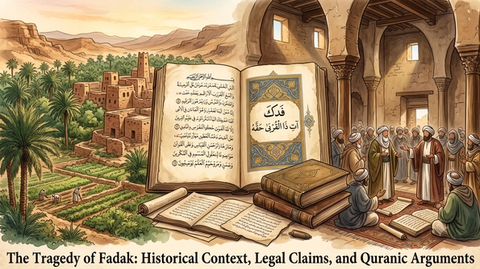
In our previous articles on the issue of Fadak, we explained that, by the command of Allah, the Prophet of Islam gifted Fadak to his only daughter, Lady Fatimah al-Zahra (sa), and that she had taken possession of it. However, after the Prophet’s passing, when the caliphate came into the hands of Abu Bakr following the events at Saqifah, one of the first actions attributed to his administration was to take control of Lady Fatimah’s property and remove her agents from the garden of Fadak.
When Lady Fatimah al-Zahra (sa) learned of this, she repeatedly demanded Fadak from the caliph of the time. According to some reports, after hearing Lady Fatimah’s argument and accepting her claim, Abu Bakr wrote to the official he had appointed over Fadak, instructing him to hand the property back to her. However, Umar took the letter and tore it up.[1]
When Lady Fatimah (sa) resisted, reports in Shia historical literature state that Umar struck her, causing her earrings to be pulled and her ear to be injured.[2] Despite her repeated demands, the dispute continued on the basis of a hadith cited as follows:
“We, the community of prophets, do not leave inheritance; whatever we leave is charity.”[3]
The Princess of Islam is reported to have responded by asking whether anyone other than Abu Bakr had heard this hadith from the Messenger of Allah. She is also reported to have argued that, even if others were brought forward to corroborate it, the claim would still conflict with the Qur’an, because her father could not say anything contrary to the Book of Allah.
The Qur’an sets out rules concerning inheritance. If those rules allow others to inherit from their fathers, how, she is reported to have argued, could she be excluded from those same rules? On this basis, she rejected the attribution of the hadith to the Messenger of Allah.
While recording this historical dispute, Ibn Abi al-Hadid discusses the transmission of the hadith and is cited in connection with the observation that Abu Bakr was its sole transmitter from the Prophet in this particular dispute.[4] The question of how this report should be understood alongside the Qur’anic passages concerning inheritance remains central to the differing interpretations of the Fadak controversy.[5]
Dear respected readers,
Although Lady Fatimah al-Zahra (sa) had no attachment to worldly wealth, it was necessary for her to assert her right and formally register her protest. Such a protest serves to prevent the unlawful appropriation of another person’s rights and to protect people from injustice. It is also necessary to strive to ensure that rightful claims reach their rightful owners. For this reason, lifting the veil from the face of injustice was essential.
Another concern was that the property should not pass into the hands of someone who might spend its revenues according to personal desires, leaving those entitled to benefit from it deprived. Historical accounts state that Fadak was later transferred to Marwan, whom the author describes as an enemy of Allah and His Messenger, and that he spent its revenues improperly. The circumstances and chronology of Fadak’s transfer differ across historical accounts; some sources associate the grant with Uthman, while another historical account attributes it to Mu‘awiyah.[6]
Marwan was the son of al-Hakam ibn Abi al-As. Biographical and historical sources contain accounts concerning al-Hakam’s expulsion from Medina during the Prophet’s lifetime and his later return. Reports differ regarding the circumstances and interpretation of these events. The author’s account maintains that al-Hakam and Marwan were not permitted to return during the caliphates of Abu Bakr and Umar, while al-Hakam was allowed to return during Uthman’s caliphate and was given an official position.[7]
The Commander of the Faithful, Imam Ali (as), is quoted in Nahj al-Balagha as saying:
“Yes, Fadak was in our possession; yet they were miserly with it and took it away from us.”
He then says:
“And Allah is the best of judges.”[8]
God willing, justice will be served through divine judgment on the Day of Resurrection.
“Those who have done wrong will come to know to what end they will return.” — Qur’an 26:227
“Indeed, the curse of Allah is upon the wrongdoers.” — Qur’an 11:18
Endnotes and references
[1] The dispute over Fadak and the Prophet’s estate
Sahih al-Bukhari, Hadith 3092–3093 and 6725–6726, records Lady Fatimah’s request concerning the Prophet’s estate, Abu Bakr’s response, and the subsequent estrangement described in the narration.
Read the relevant narrations on Sunnah.com.
- Sunnah.com
[2] The hadith concerning prophetic inheritance
The wording cited in the article is recorded in Sunni hadith collections, including Sahih al-Bukhari and Sahih Muslim. The collections provide the textual basis for Abu Bakr’s stated position in the dispute.
Sahih al-Bukhari — Fadak narrations
Sahih Muslim — search for Fadak
[3] Fadak as a gift to Lady Fatimah
Shia sources record reports that the Prophet gave Fadak to Lady Fatimah. Relevant material appears in Bihar al-Anwar, compiled by Muhammad Baqir al-Majlisi, vol. 29.
- Read Bihar al-Anwar, vol. 29. HubeAli
[4] The written document and its alleged destruction
A report describing Abu Bakr issuing a written document concerning Fadak, followed by Umar taking and tearing it, is cited in Shia literature, including Bihar al-Anwar, vol. 29. This reference should be understood as the source for the reported account, not as an independent determination of its historical authenticity.
Bihar al-Anwar, vol. 29 — Arabic text
[5] Reports of physical mistreatment
For the reports concerning alleged physical mistreatment of Lady Fatimah, see Vinay Khetia, Fatimah as a Motif of Contention and Suffering in Islamic Sources (Master’s thesis, Concordia University, 2013). The study examines reports preserved in Islamic literature and discusses their sources and transmission.
[6] Qur’anic passages concerning inheritance
The article refers to Qur’anic accounts of inheritance, including the inheritance of the prophets. Relevant passages include:
Qur’an 4:7 — Inheritance rights
Qur’an 4:11–12 — Rules of inheritance
Qur’an 19:5–6 — Zakariyya’s prayer concerning an heir
Qur’an 27:16 — Sulayman inheriting Dawud
Qur’an 17:26 — Giving relatives their due
[7] Fadak in later historical accounts
Historical accounts differ concerning the later transfer of Fadak and the individuals to whom it was assigned. A survey of the relevant reports and references is available in A Short History of Fadak after the Martyrdom of Fatimah (sa).
- Read the historical overview
[8] The account attributed to Imam Ali in Nahj al-Balagha
The article quotes the passage beginning “Balā, kānat fī aydīnā Fadak” (“Yes, Fadak was in our possession”), associated with Letter 45 in commonly used editions of Nahj al-Balagha. Numbering and commentary may vary between editions.
- Read the passage and accompanying references
[9] Reports concerning al-Hakam ibn Abi al-As
For biographical reports about al-Hakam ibn Abi al-As and accounts concerning his exile and later return, consult Ibn Abd al-Barr’s Al-Isti'ab, under the entry for al-Hakam ibn Abi al-As. Historical accounts and later interpretations differ on aspects of this episode.
Biographical discussion and references
[10] Qur’anic closing verses
Qur’an 26:227 — “Those who have done wrong will come to know…”
Qur’an 11:18 — “Surely, the curse of Allah is upon the wrongdoers.”