

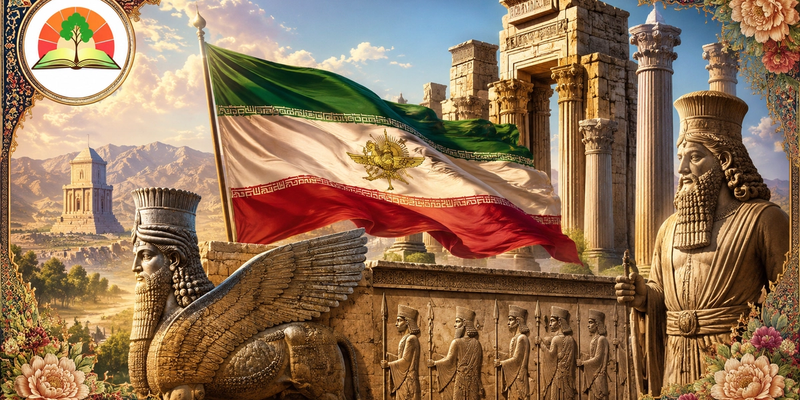
Those who label Iran as "Majuus" (Zoroastrian/Magian) must first study history. To brand an entire nation with a derogatory label based on its pre-Islamic religious heritage from centuries ago is neither scholarly, rigorous, nor just. If history is examined with objectivity rather than prejudice, it becomes evident that Persia—and the broader Iranian and Khurasanian cultural realm—is not merely a geographic designation, but a foundational center of scholarship, civilization, intellectual thought, and religious service in Islamic history.
The Iranian connection to Islam did not begin with a single political conquest; individuals of Persian descent embraced Islam during the era of the Prophet Muhammad himself. Foremost among them was Salman al-Farsi (may Allah be pleased with him), recognized by historical scholarship as the first prominent Muslim figure of Persian origin and a living symbol of early Persian conversion to Islam.
The journey of Salman al-Farsi (ra) serves as a profound starting point. He was a Persian seeker of truth who traveled far, experienced diverse religious traditions, relentlessly pursued spiritual knowledge, and ultimately reached the presence of the Prophet Muhammad (peace and blessings be upon him and his family) to accept Islam. He became an eminent Companion of the Prophet and attained an exceptional status, forever linked with the Ahl al-Bayt (the Prophet's Household). During the Battle of the Trench (Khandaq), when both the Muhajirun (Emigrants) and the Ansar (Helpers) claimed Salman among their ranks with pride, the Messenger of Allah (pbuh) declared:
«سَلْمَانُ مِنَّا أَهْلَ الْبَيْتِ»
"Salman is of us, the Ahl al-Bayt."
(Recorded by Imam al-Hakim al-Nishapuri in Al-Mustadrak 'ala al-Sahihayn and Imam al-Bayhaqi in Dala'il al-Nubuwwah)
This declaration illustrates the foundational Islamic principle that human worth is not determined by race, language, or geography, but by faith, sincerity, spiritual discernment, and character. That the Prophet of Allah elevated a Persian man to a familial bond with the Ahl al-Bayt proves that the relationship between Persia and Islam cannot be reduced to political conquests. Salman (ra) stands as an enduring emblem where the land of Persia, the earnest quest for truth, and the universal ethos of Islam converged.
The broader intellectual milieu of the Iranian and Khurasanian regions developed significantly over the centuries. The adoption of Islam in Iran was a gradual, multi-century process; by the tenth century CE, the Iranian sphere had largely become Islamic, though the timeline and conditions varied across regions. Following this transition, the region became pivotal in developing the Islamic sciences. It should be clarified that while historic cities such as Bukhara, Tirmidh, Nisa, and Herat lie outside the borders of modern-day political Iran, they were integral components of the historical Iranian-Khurasanian cultural and scholarly ecosystem. Referring to them as part of the Iranian intellectual tradition is historically accurate, even if distinct from the borders of modern Iran.
A review of the foundational Hadith corpuses illustrates this legacy:
- Imam Muhammad ibn Isma'il al-Bukhari hailed from Bukhara.
- Imam Muslim ibn al-Hajjaj al-Nishapuri hailed from Nishapur.
- Imam Abu 'Isa al-Tirmidhi hailed from Tirmidh.
- Imam Ahmad ibn Shu'ayb al-Nasa'i hailed from Nisa.
- Imam Ibn Majah al-Qazwini hailed from Qazvin.
- Imam Abu Dawud al-Sijistani hailed from Sijistan.
This intellectual landscape also produced master traditionists such as Imam al-Hakim al-Nishapuri, Imam al-Bayhaqi, and Imam Ibn Khuzaymah. Their works form the bedrock of the Islamic Hadith tradition. To disregard this entire scholarly environment and reduce Iranian civilization to a single pejorative term is to disregard a substantial portion of Islamic intellectual history.
This scholarly contribution extended far beyond Hadith:
- Classical biographical sources document the Persian lineage of Imam Abu Hanifah.
- Imam Abu Hamid al-Ghazali hailed from Tus.
- Imam Fakhr al-Din al-Razi hailed from Rayy.
- Imam Muhammad ibn Jarir al-Tabari hailed from Amol.
Ghazali’s Ihya' 'Ulum al-Din, Razi’s Mafatih al-Ghayb, and Tabari’s Jami' al-Bayan and Tarikh al-Rusul wa al-Muluk remain monumental masterworks of Islamic theology, exegesis (tafsir), and history. Centers such as Nishapur, Tus, Rayy, Qazvin, Amol, and Khurasan produced countless authorities across Islamic jurisprudence (fiqh), theology (kalam), philosophy, Sufism, literature, and historiography.
This reveals a clear intellectual contradiction: how can one study Sahih al-Bukhari, cite Sahih Muslim, quote narrations from al-Tirmidhi, al-Nasa'i, Ibn Majah, and Abu Dawud, benefit from the works of al-Hakim and al-Bayhaqi, and read the treatises of al-Ghazali, al-Razi, and al-Tabari, while simultaneously dismissing their entire cultural and historical background as "Majuus"? To accept the scholars' books while reviling their cultural roots is an intellectual double standard.
Iran’s religious history is multifaceted and cannot be summarized in a single sweeping generalization. Following the advent of Islam, Iran sustained a long and robust Sunni scholarly tradition alongside devotion to the Ahl al-Bayt and active Shi'i scholarship across various eras. Over time, the Shi'i scholarly tradition expanded through research, seminary teaching, legal deduction (ijtihad), debate, and composition. The Safavid era marked a major turning point when Twelver (Ithna 'Ashari) Shi'ism was declared the state religion, altering Iran's demographic profile. However, Shi'ism was not simply invented by royal decree; Shi'i intellectual currents existed long before the Safavids, who provided state patronage and institutional consolidation.
Furthermore, this demographic transition was gradual. Historical evidence shows that by the mid-sixteenth century, major urban centers like Qazvin, Shiraz, and Hamadan still had substantial Sunni populations, and as late as circa 1720, an Ottoman observer noted that nearly one-third of the Iranian population remained Sunni. This illustrates that Iran’s contemporary religious demographic was formed through a lengthy historical and intellectual process.
A sound scholarly approach requires evaluating Iran's historical epochs distinctly:
- The ancient pre-Islamic Persian religions.
- The gradual, multi-century conversion to Islam.
- The centuries-long Sunni intellectual tradition.
- The flourishing of Shi'i thought centered on the Ahl al-Bayt.
- The establishment of Shi'ism as the state religion during the Safavid era.
Collapsing all these diverse phases into the single label of "Majuus" is not historical analysis; it is an evasion of history.
Islam does not assess human dignity through ancestral religions. The Quranic criterion is unambiguous:
﴿إِنَّ أَكْرَمَكُمْ عِندَ اللَّهِ أَتْقَاكُمْ﴾
"Indeed, the most noble of you in the sight of Allah is the most righteous of you." (Al-Hujurat: 13)
If one disagrees with the theological positions of Iranian scholars, let it be debated through rigorous scholarship. If one disagrees with the foreign or domestic policies of the Iranian state, let those policies be evaluated critically. If one objects to the positions of an individual scholar or political leader, respond with reasoned arguments. But to denigrate an entire civilization with the name of a religion its ancestors left centuries ago contradicts intellectual integrity.
Dismissing modern Iran as "Majuus" reflects a lack of historical and cultural awareness. While studying a nation's past is necessary, transforming that ancient past into an immutable label for every contemporary descendant is unjust. If applied universally, very few modern societies would escape being designated by the religions of their distant ancestors.
The history of the Iranian civilization offers a fundamental lesson: Islam is not the exclusive domain of any single race, language, or territory. Salman al-Farsi (ra) rose from Persia to be counted among the beloved companions of the Prophet; the scholars of Khurasan and Transoxiana compiled the foundational canon of Hadith; and centers like Tus, Nishapur, Rayy, and Amol produced foundational figures in Islamic jurisprudence, exegesis, philosophy, and history. All of this belongs to the shared heritage of Islamic civilization.
Before reducing Iran to the label of "Majuus," study the life of Salman al-Farsi (ra); examine the lineages and biographies of the compilers of Bukhari and Muslim; read the treatises of al-Ghazali, al-Razi, and al-Tabari; and investigate the intellectual history of Iran and Khurasan. History is not a tool to cage an entire people within a pejorative term, but a discipline meant to trace and understand their civilizational journey.
To dismiss the very land that produced Salman al-Farsi (ra), formed pillars of classical Islamic scholarship, and evolved through centuries of intellectual and religious transformation as merely "Majuus" is an injustice to history, scholarship, and basic fairness.
Disagree with knowledge, critique with sound evidence, and when narrating history, present the entire record. Before calling Iran "Majuus," read its history—for genuine historical inquiry fosters objective truth, not prejudice.

