
Episode 2: The True and Sincere Way of Offering Condolences
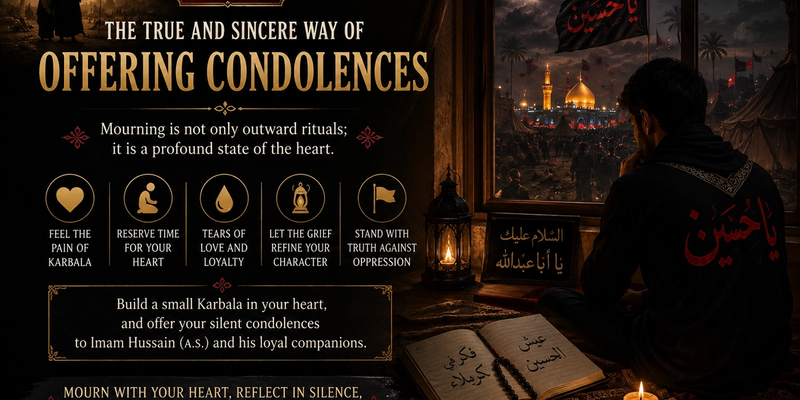
Mourning is not merely a collection of outward rituals; it is a profound state of the heart. The beauty of gatherings, the grandeur of processions, the impact of elegies, and the passion of matam all hold immense significance. They are living expressions of love for Imam Hussain (A.S.), and through them, the message of Karbala has been passed down from generation to generation for centuries.
Yet, alongside all of this, there is another dimension—one that may be even closer to the true spirit of mourning.
Our processions and gatherings have their own requirements. They need order, discipline, and organization. These are unavoidable necessities, and without them, managing large assemblies would be impossible. However, the grief of Imam Hussain (A.S.) is not only a matter of organization; it is also a matter of feeling and reflection.
For this reason, during these blessed days, we should reserve some time for our hearts as well—moments in which we step away from the distractions of the world and quietly remember Karbala.
Sit alone for a while and reflect: What must thirst have felt like on the banks of the Euphrates? What was the anguish inside the tents? How unbearable was the suffering of Ali Asghar (A.S.)? What pain must Lady Zainab (S.A.) have carried in her heart? And how did Imam Hussain (A.S.), the beloved grandson of the Holy Prophet (PBUH), endure those final moments among the bodies of his loved ones?
When a person tries to witness these tragedies through the eyes of the heart, mourning takes on an entirely new meaning.
Some pains cannot be expressed; they can only be felt. The grief of Karbala is one of those pains. It reaches that corner of the heart where words can no longer go. There are no speeches there, no elegies, and no other means of expression—only a heart offering condolences to the Martyr of Karbala and a few tears that become the language of devotion, love, and loyalty.
Perhaps this is the state in which mourning reveals its true power. A person no longer weeps merely for reward but connects their heart to the grief of Imam Hussain (A.S.). That grief then descends into their life as a light, bringing truthfulness to their character, awakening their conscience, and giving them the courage to stand with truth against oppression.
Muharram and Ashura do not merely invite us to commemorate a memory; they invite us to let that memory live within our hearts.
Fortunate are those who benefit from all the blessings of gatherings, processions, and acts of mourning, while also building a small Karbala within their hearts—a place where they quietly offer their condolences to Imam Hussain (A.S.) and his loyal companions.
Perhaps within this sincerity lies the light that beautifies both this world and the next.


Maulana Sayed Karamat Husain
Maulana Syed Karamat Hussain Jafari, a religious scholar from Poonch (Jammu and Kashmir), has served In the field of religious and social services, he played a prominent role in the establishment of Jamia Fatima Zahra (a.s.) Mumbai, several mosques and Hussainis. As a translator, writer and researcher, he has rendered valuable academic services on important issues of history, beliefs, ethics, biography, Palestine, Gaza, Quds and the world of Islam through dozens of books and more than three thousand articles.